
Ngày 8 — Future time: present continuous, will, be going to, present simple
Học cách nói về tương lai và luyện năm kỹ năng.
Ngữ pháp — Destination B1, Unit7
Mầm 1
- Làm gì: Học Destination B1 Unit7 — Future time.
- Bao nhiêu câu: 50 câu, phần A–G — đúng 40 câu (80%) là đạt
- Luật riêng của dạng này: Phân biệt lịch hẹn, thời khóa biểu, ý định, dự đoán và quyết định ngay lúc nói. Phần G ôn quá khứ hoàn thành.
- Xong thì làm gì: Tự sửa những câu sai rồi nộp.
- Em có thể chia thành 2 lượt, không cần làm hết một mạch.
A. Lịch hẹn đã sắp xếp (6 câu)
Các việc đã có trong lịch của Shelley. Dùng hiện tại tiếp diễn: is + V-ing. Điền cụm động từ, không viết lại chủ ngữ.
- On Monday, Shelley (meet) Alison at Friends Café.
- On Tuesday, she (go) shopping with Mum.
- On Wednesday, she (catch) a train to Brighton.
- On Thursday, she (spend) the day with Charlie in Brighton.
- On Friday, she (catch) the train home at ten in the morning.
- On Saturday, she (work) in Dad's shop all morning.
B. Will và shall (8 câu)
Dùng will + động từ nguyên mẫu; lời đề nghị dạng câu hỏi với I/we dùng shall. Ngữ cảnh từ bài B, chuyển sang chọn cụm để tránh tách một đáp án thành hai ô.
- This year, more than a million tourists ______ our local area.
A will visit · B will visiting · C shall visiting - I’m sure we ______ your bag soon. Where did you last see it?
A will finding · B will find · C will found - ______ me some money until Saturday?
A Will you lend · B Will you lending · C Shall you lent - Everything on the menu looks delicious! Erm… I ______ Chicken Kiev, please.
A will having · B will had · C will have - I ______ you to the bus station, if you like.
A will taking · B will take · C will took - One day, people ______ on Mars in special buildings.
A will live · B will living · C will lived - No, there ______ any problems with delivering your new furniture next week.
A will not being · B will not be · C will not been - Lời đề nghị giúp chuẩn bị bữa tối: ______ at six to help you get things ready?
A Shall we coming · B Shall we came · C Shall we come
C. Be going to (8 câu)
Dùng am/is/are going to + động từ nguyên mẫu; có câu phủ định. Hai câu hỏi đã cho sẵn Is để chỉ còn một ô liên tục.
- When I grow up, I (play) guitar in a rock group!
- Rick and Mark (start) going to the gym twice a week.
- Is Lauren (tell) her mum about what happened?
- I (look) on the Internet for information about snowboarding.
- No, Nadine (invite) everyone from class — just her close friends.
- Is Harry (be) ready on time or not?
- Careful! You (break) something with that ball! Go outside!
- I (lie down) for half an hour. Call me at six o'clock.
D. Thời khóa biểu và lịch trình (4 câu)
Dùng hiện tại đơn theo yêu cầu bài D. Chủ ngữ my plane là số ít; we dùng động từ nguyên mẫu. Bốn câu giữ nguyên thứ tự của đoạn văn lịch trình.
- My plane (leave) the airport here at nine o'clock.
- We (arrive) in Paris two hours later.
- We then (take) the train from the airport to the city.
- We (come) back on the 17th.
E. Chọn dạng theo tình huống (10 câu)
Chọn A hoặc B theo mục đích đã ghi. Một sự việc tương lai có thể diễn đạt nhiều cách; ở đây mỗi câu chỉ rõ lịch hẹn, ý định hay lời đề nghị cần luyện.
- Oscar vừa tự nguyện nhận rửa bát sau bữa tối. Chọn lời nhận việc: Oscar says he ______ the washing-up after dinner.
A is doing · B will do - I’ve booked the appointment. I ______ the dentist this afternoon.
A am seeing · B will see - Hỏi ý định tối nay: What ______ this evening?
A are you going to do · B do you do - Nhờ Rupert được báo lời xin lỗi: ______ Rupert I’m sorry about yesterday?
A Shall you tell · B Will you tell - Dad has decided to grow a beard. He ______ a beard, but Mum doesn’t like the idea.
A will grow · B is going to grow - Theo lịch thi đã sắp xếp, we ______ an exam tomorrow.
A are having · B will have - Lời khẳng định về tương lai: I ______ this day for the rest of my life!
A am remembering · B will remember - Hỏi chuyến đi đã sắp xếp vào Giáng sinh tới: ______ to Australia next Christmas?
A Do you go · B Are you going - Dự đoán để động viên: I’m sure you ______ your driving test. Don’t worry.
A are passing · B will pass - Lời đề nghị ngay lúc nói: If you want me to, I ______ to the manager about it.
A will complain · B am going to complain
F. Hội thoại ngắn (6 câu)
Chọn A, B hoặc C phù hợp cấu trúc và mục đích nói đã cho.
- Have you made plans for the summer? — Yes. ______ to Spain.
A We'll go · B We're going · C We go - We’re moving house tomorrow. — Really? ______ you with the furniture. (Vừa đề nghị giúp.)
A I help · B I'm helping · C I'll help - Do you need this paintbrush? — Ah, yes. ______ it to me, please?
A Do you pass · B Will you pass · C Are you passing - What do you want to be when you grow up? — ______ a scientist. That’s what I want to do.
A I be · B I'm going to be · C I'm being - John is a better player than Martin. — Oh, yes. ______ the match tomorrow, I expect.
A He'll win · B He wins · C He's winning - The weather has been terrible. — Yes, I think ______ again later.
A it's going to rain · B it's raining · C it rains
G. ÔN LẠI — Quá khứ hoàn thành (8 câu)
Ôn Unit5 bằng câu mới. Dùng quá khứ hoàn thành đơn cho việc hoàn tất trước mốc quá khứ; dùng quá khứ hoàn thành tiếp diễn khi câu nhấn quá trình kéo dài gây ra trạng thái lúc đó.
- By the time the shop opened, we (wait) outside for twenty minutes.
- The teacher (already / mark) our tests before the lesson began.
- His boots were muddy because he (walk) through wet fields for hours.
- We couldn't unlock the door because I (leave) the key at work.
- She (not / read) the instructions before she started the machine.
- (you / ever / ride) a horse before that holiday?
- They were tired because they (carry) boxes all morning.
- The bus (just / go) when we reached the stop.
Đọc — Australian parrots
Mầm 2
- Làm gì: Đọc về tác động của thay đổi môi trường lên các loài vẹt.
- Bao nhiêu câu: 10 câu — đúng 5 câu (45%) là đạt
- Luật riêng của dạng này: 1–6: không quá HAI TỪ. 7–10: TRUE/FALSE/NOT GIVEN. Tìm bằng chứng trong ba đoạn.
- Xong thì làm gì: Kiểm tra, tự sửa rồi bấm Nộp bài.
Bài: Australian parrots — changing habitats — đoạn G–I của đề1515, đánh lại A–C; đã sửa ba lỗi đánh máy. Câu hỏi biên soạn cho đoạn trích. Bài nằm ngay trên trang, con không cần mở đường dẫn nào.
Today, most of Australia's parrots inhabit woodland and open forest, and their numbers decline towards both deserts and wetter areas. The majority are nomadic to some degree, moving around to take advantage of feeding and breeding places. Two of the dry country parrots, the pink and grey galah and the pink, white and yellow corella have expanded their ranges in recent years. They are among the species that have adapted well to the changes brought about by European settlement: forest felling created grasslands where galahs and corellas thrive.
But other parrot species did not fare so well when their environments were altered. The clearing of large areas of rainforest is probably responsible for the disappearance of the double-eyed fig parrot, and numbers of ground parrots declined when a great part of their habitat was destroyed by the draining of coastal swamps. Even some parrot species that benefited from forest clearing at first are now confronted by a shortage of nesting sites due to further man-made changes.
New conditions also sometimes favour an incoming species over one that originally inhabited the area. For example, after farmers cleared large areas of forest on Kangaroo Island off the coast of South Australia, the island was colonised by galahs. They were soon going down holes and destroying black cockatoo eggs in order to take the hole for their own use. Their success precipitated a partial collapse in the black cockatoo population when the latter lost the struggle for scarce nesting hollows.
Đọc trước khi làm bài — 14 từ và cụm từ
| Cụm | Nghĩa | Câu nguyên văn trong bài |
|---|---|---|
| inhabit | sống ở | Today, most of Australia’s parrots inhabit woodland and open forest, and their numbers decline towards both deserts and wetter areas. |
| woodland | vùng có cây rừng | Today, most of Australia’s parrots inhabit woodland and open forest, and their numbers decline towards both deserts and wetter areas. |
| decline | giảm | Today, most of Australia’s parrots inhabit woodland and open forest, and their numbers decline towards both deserts and wetter areas. |
| nomadic | di chuyển nơi sống | The majority are nomadic to some degree, moving around to take advantage of feeding and breeding places. |
| breeding | sinh sản | The majority are nomadic to some degree, moving around to take advantage of feeding and breeding places. |
| expanded | mở rộng | Two of the dry country parrots, the pink and grey galah and the pink, white and yellow corella have expanded their ranges in recent years. |
| ranges | vùng phân bố | Two of the dry country parrots, the pink and grey galah and the pink, white and yellow corella have expanded their ranges in recent years. |
| thrive | phát triển mạnh | They are among the species that have adapted well to the changes brought about by European settlement: forest felling created grasslands where galahs and corellas thrive. |
| clearing | việc phát quang | The clearing of large areas of rainforest is probably responsible for the disappearance of the double-eyed fig parrot, and numbers of ground parrots declined when a great part of their habitat was destroyed by the draining of coastal swamps. |
| habitat | môi trường sống | The clearing of large areas of rainforest is probably responsible for the disappearance of the double-eyed fig parrot, and numbers of ground parrots declined when a great part of their habitat was destroyed by the draining of coastal swamps. |
| draining | việc tháo cạn nước | The clearing of large areas of rainforest is probably responsible for the disappearance of the double-eyed fig parrot, and numbers of ground parrots declined when a great part of their habitat was destroyed by the draining of coastal swamps. |
| swamps | đầm lầy | The clearing of large areas of rainforest is probably responsible for the disappearance of the double-eyed fig parrot, and numbers of ground parrots declined when a great part of their habitat was destroyed by the draining of coastal swamps. |
| colonised | đến sống và chiếm chỗ | For example, after farmers cleared large areas of forest on Kangaroo Island off the coast of South Australia, the island was colonised by galahs. |
| scarce | khan hiếm | Their success precipitated a partial collapse in the black cockatoo population when the latter lost the struggle for scarce nesting hollows. |
Câu 1–6 — Không quá HAI TỪ
Tự làm trước khi xem giải thích.
- What type of land was created when forest was felled?
A: forest felling created grasslands.
- Which parrots destroyed eggs to take over nesting holes?
C: the island was colonised by galahs; They chỉ galahs ở câu trước.
- Which birds suffered a partial population collapse?
C: a partial collapse in the black cockatoo population; nhận danh từ chỉ loài hoặc số nhiều.
- What kind of sites became scarce for some parrots?
B: a shortage of nesting sites; câu hỏi hỏi loại vị trí.
- What coastal areas were drained, destroying habitat?
B: the draining of coastal swamps.
- On which island did farmers clear large areas of forest?
C: Kangaroo Island off the coast of South Australia.
Câu 7–10 — TRUE / FALSE / NOT GIVEN
Tự làm trước khi xem giải thích.
- Most Australian parrots live in deserts.
A nói most sống ở woodland and open forest, số lượng giảm về phía sa mạc.
- Every parrot species benefited from forest clearing.
B nêu loài biến mất hoặc giảm số lượng khi môi trường bị phá; Every trái với thông tin này.
- Black cockatoos lost the struggle for scarce nesting hollows.
C nói when the latter lost the struggle for scarce nesting hollows; latter là black cockatoo.
- The galahs on Kangaroo Island were brought there directly from Europe.
A nhắc European settlement nhưng không nêu nguồn gốc hay đường di chuyển của galahs đến đảo; không ghép hai thông tin thành một quan hệ không có trong bài.
1. Hỏi lại nội dung bài
Trả lời bằng lời của con, không cần viết dài.
- Vì sao thay đổi môi trường có thể giúp loài này nhưng hại loài khác?
- Tìm hai hậu quả khác nhau của việc mất nơi sống trong đoạn B.
- Nêu điều bài chưa nói để giải thích câu10 NOT GIVEN.
2. Cụm từ trong đoạn trích
| Từ / cụm | Nghĩa | Tìm trong bài rồi đặt câu mới |
|---|---|---|
| take advantage of | tận dụng | take advantage of feeding and breeding places (đoạn A) |
| a shortage of | sự thiếu hụt | a shortage of nesting sites (đoạn B) |
3. Key table IELTS (bảng Paraphrase) — bài dùng từ nào thay cho từ trong câu hỏi?
| Câu | Từ trong CÂU HỎI | Cụm trong bài |
|---|---|---|
| 2 | take over a nesting place | |
| 3 | a fall in numbers | |
| 4 | not enough nesting places |
Gọi lại từ đã học trong ngữ cảnh mới; không cộng điểm chính.
Đáp án key table và chỗ tìm ra trong bài
| Câu | Từ trong bài | Nằm ở |
|---|---|---|
| 2 | take the hole for their own use | C |
| 3 | a partial collapse | C |
| 4 | a shortage of nesting sites | B |
Không ghép European settlement ở đoạn A với galahs ở đoạn C để suy rằng chim được đưa từ châu Âu đến đảo.
Nghe — Museum work placement
Mầm 3
- Làm gì: Nghe hướng dẫn cho tuần thực tập tại bảo tàng.
- Bao nhiêu câu: 10 câu — đúng 5 câu (45%) là đạt
- Luật riêng của dạng này: 1–5 chọn A–C. 6–10 nhìn sơ đồ và điền chữ A–I. Hãy xác định Entrance, cầu thang và quầy tiếp tân trước khi nghe.
- Xong thì làm gì: Kiểm tra, tự sửa rồi bấm Nộp bài.
Bài: Museum work placement — các quy định thực tập và hướng dẫn tìm phòng. Câu hỏi trắc nghiệm diễn đạt lại; giữ bài chỉ đường trên sơ đồ. Bài nằm ngay trên trang, con không cần mở đường dẫn nào.
Bài nghe hôm nay — một nhân viên bảo tàng hướng dẫn nhóm học sinh chuẩn bị thực tập.. (Đề này không cho biết đây là phần nào của bài thi, nên cô chưa xác định được là Part mấy — con cứ nghe và làm bình thường.)
Câu 1–5 — Work placement
Tự làm trước khi xem giải thích.
- Which hours apply on the first Monday?
- 09:00–17:00
- 08:45–17:00
- 09:00–16:45
0:33: thứ Hai đầu tiên phải đến8:45, sớm hơn thường lệ15 phút; vẫn kết thúc17:00. - What should trainees normally put on inside the museum?
- A formal suit
- A museum-branded cap
- Their usual informal clothes
1:06: trong bảo tàng mặc đồ thường ngày vì công việc có bụi/bẩn. Mũ có logo dành cho khi đi ra ngoài. - Who should a trainee call first about illness or delay?
- The person at reception
- The assigned museum supervisor
- The teacher at school
1:36: gọi tiếp tân; tiếp tân sẽ báo người giám sát. Nếu nghỉ hơn một ngày, bảo tàng mới báo nhà trường. - Which activity do trainees generally enjoy most?
- Giving talks at primary schools
- Interviewing older residents in care homes
- Running art sessions on site
2:12: hoạt động được ưa thích nhất là đến nhà chăm sóc người cao tuổi và ghi lại ký ức thời đi học. - What reading is recommended before the placement begins?
- Online material about the museum's past
- Health and safety rules
- Earlier trainees' written feedback
2:44: nên đọc đánh giá/ghi chú của người đã thực tập; người giám sát sẽ hướng dẫn an toàn và lịch sử bảo tàng sau.
Câu 6–10 — Museum plan
Write one letter A–I for each place. Start from the main entrance when following directions.
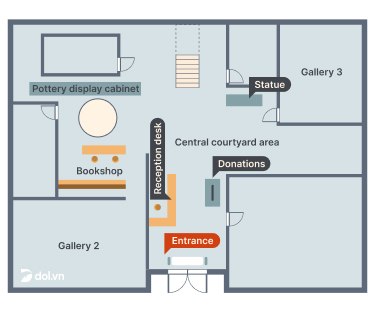 ABCDEFGHI
Phóng to sơ đồ — kéo ngang để xem toàn hình
ABCDEFGHI- Sign-in office
3:14: từ cửa chính nhìn cầu thang phía trước; tượng ngựa ở bên phải, cửa phía sau tượng dẫn vào phòng C.
- Gallery 1
3:36: tìm hòm quyên góp gần lối vào sân giữa; cửa phía sau hòm dẫn vào phòng I.
- Key box
3:55: đi phía sau quầy tiếp tân; hộp khóa H nằm giữa phòng trưng bày lớn và hiệu sách.
- Kitchen area
4:23: đi vòng quanh quầy tiếp tân tới tủ tròn; cửa phía sau tủ dẫn tới khu D.
- Staff noticeboard
4:43: bảng ở góc phía sau khu vui chơi, trên tường Gallery3; vị trí G.
1. Hỏi lại nội dung bài
Trả lời bằng lời của con, nghe lại nếu cần.
- Ngày đầu đến sớm hơn thường lệ bao lâu?
- Vì sao không gọi người giám sát trước khi báo đi muộn?
- Mô tả đường từ Entrance đến Gallery1 bằng lời của em.
2. Cụm giúp hiểu chỉ dẫn
| Từ / cụm | Nghĩa | Vận dụng hai cụm trong câu mới |
|---|---|---|
| ahead of | trước một mốc | well ahead of opening time (đoạn ) |
| get hold of | tìm/lấy được | get hold of evaluations (đoạn ) |
3. Key table IELTS (bảng Paraphrase) — người nói dùng từ nào thay cho từ trong cụm nghe được?
Nghe lại phần liên quan rồi điền cụm phù hợp.
| Câu | Từ trong CÂU HỎI | Cụm trong lời băng |
|---|---|---|
| 1 | the ordinary finishing time | |
| 3 | on time | |
| 5 | advice from earlier trainees |
Các ô post không cộng điểm.
Mở phần này sau khi con đã nộp bài — nhìn transcript trước thì con mất đúng phần khó nhất của bài nghe: tự tách ra từng từ và nghe ra chỗ nói rút gọn.
Transcript
Chỉ mở transcript sau khi đã làm bài và nghe lại. Dùng các mốc trong giải thích để tìm đoạn cần nghe; bản chữ nguồn có vài lỗi đánh máy.
Phân biệt thông tin thường ngày với ngoại lệ ngày đầu. Với sơ đồ, bám vật mốc và xác định phía sau, giữa, góc tường.
Shadowing — Wild animals
Mầm 4
- Làm gì: Đọc theo câu hỏi xác nhận của Sam.
- Bao nhiêu câu: một câu hỏi — đúng đủ bốn tiêu chí là đạt
- Luật riêng của dạng này: Nhấn wild animals; giữ giọng hỏi ở right.
- Xong thì làm gì: Thu bằng giọng em.
0:39.28–0:42.88. BBC Learning English — Do our pets care about us? Sam xác nhận rằng cuộc trao đổi không nói về động vật hoang dã.
| Mốc | Lời |
|---|---|
| 0:39.28 | Now, Neil, obviously we're not talking about wild animals, right? |
Năm bước làm
- Nghe và hiểu ý câu hỏi.
- Chia cụm: Now, Neil / obviously / we’re not talking about wild animals / right?
- Nhắc từng cụm hai lần.
- Đọc theo ba lần, chú ý âm cuối wild và animals.
- Tắt mẫu và thu lại cả câu.
Thế nào là một bản thu đạt
Đủ câu; rõ wild và animals; giọng hỏi tự nhiên; bản thu chỉ có giọng em.
Nói & Viết
Mầm 5
- Làm gì: Kể về kế hoạch đi thăm một nơi và viết quan điểm về bảo vệ chim hoang dã.
- Bao nhiêu câu: một bài Part2 và một đoạn Task2 — đúng đủ ý, có lý do và ví dụ là đạt
- Luật riêng của dạng này: Nói dùng will/going to hoặc hiện tại tiếp diễn đúng với mức độ đã sắp xếp. Viết đoạn ngắn nêu một quan điểm.
- Xong thì làm gì: Nộp cả link Nói và link Viết.
A. NÓI — Part 2
Part 2 (ghi chú từ khóa rồi nói khoảng một phút)
Describe a place you would like to visit in the future.
- Where it is
- Who you would like to go with
- What you plan to do there
- And explain why you want to visit it.
Thế nào là một bài Nói đạt
Nêu địa điểm, người đi cùng, hoạt động và lý do. Phân biệt mong muốn với lịch hẹn đã chốt; không dùng hiện tại tiếp diễn cho một dự đoán.
B. VIẾT — Task 2
Task 2 (60–70 từ, 13 phút)
Some people think towns should leave more space for wild birds, even if this means less space for new buildings. Do you agree or disagree? Write a short paragraph with one reason and an example.
Dàn ý Task 2 và tiêu chí chấm
Câu1 nêu quan điểm. Hai câu tiếp giải thích một lý do. Thêm một ví dụ cụ thể, rồi kết đoạn. Có thể dùng bài đọc để nghĩ về nơi sống và chỗ làm tổ; không bịa số liệu. Một ý được giải thích rõ tốt hơn danh sách nhiều ý rời.